
The great day of the Lord is near, it is near, and hasteth greatly, even the voice of the day of the Lord:
the mighty man shall cry there bitterly.That day is a day of wrath, a day of trouble and distress,
a day of wasteness and desolation, a day of darkness and gloominess, a day of clouds and thick darkness.
A day of the trumpet and alarm against the fenced cities, and against the high towers.Zephaniah 1:14-16
The two towers fell and the destruction was great. I
remember this day like no other because it had personal ramifications for my life. And afterwards while everyone was trying to figure
out what it meant I remember my father’s words that this great event had been
foretold by the prophets Isaiah and Zephaniah. I remember picking my mouth up off the floor and not really understanding what he was trying to tell me? It was a defining moment for me - one when I knew I had to know for myself what it meant. I had to have my own interpretation. I had reached the point in my life, like Nephi, when prophesied destruction would not convince me. I had to study it- for myself. (1 Nephi 11-16)
The scriptures are not just predictions of man’s doom, nor are they stories about his most unsavory mistakes. I have heard the Old Testament described as a lurid script for a
common day soap opera. And while the descriptive sagas captivate our
imaginations and help us to see the uglier side of mankind, their intended
purpose is to warn and teach us of man’s need to reverence God and His
commandments. They are meant to admonish us to live a holier more refined life filled with charity.
God's charity toward us can be found in the preservation of his word through scripture. The Bible is God's word that teaches us through story about man's past errs and triumphs. We have it because men of God obeyed his counsel and wrote it down. The entire purpose of the Book of Mormon was to keep a
record of Lehi’s family’s journey and relevance as a branch of the Israelites.
It's testimony acts as a second witness to the Bible in declaring the sacred
mission of our Lord and Savior Jesus Christ. Its entire purpose is to teach us
the importance of studying the scriptures of God so that we might learn to work
out our own salvation.
Every Book of Mormon prophet writes to not only record the
truth of God’s love, but to also leave a witness to the divinity of Christ. This divinity can best be learned through the study of the prophets written word; their purpose was to teach us to learn for ourselves through our own personal scripture study.
After sending his sons back to Jerusalem to retrieve the brass plates which contained the 1st five books of what we now know as
the Old Testament, Lehi searches them and rejoices. In them he found his
genealogy, the prophecies of all the prophets through to Jeremiah, Adam and
Eve’s story, and the commandments of Moses. Lehi prophesied that the plates would go forth to all
nations, never perish or be dimmed by time, and rejoiced when he realized
their worth:
And we had obtained the records which the Lord had commanded us, and searched them and found that they were desirable; yea, even of great worth unto us, insomuch that we could preserve the commandments of the Lord unto our children.
1 Nephi 5:21
In 1 Nephi 19 Nephi has begun to read the “1st
five books of Moses” and begins to share some of what he learns. He is instructed
to become like the scribes of ancient Jerusalem and preserve his civilizations’
most precious truths upon plates of ore. He shares his readings with his
brethren and in hopes of helping them understand Isaiah’s writings he teaches
them that the best way to understand scripture is to liken it unto ourselves. (1 N 19:23)
Like Nephi, Jacob, Enos, Omni, King Benjamin, Alma the
Elder, Zeezrom, Ether, Mormon, and Moroni all encourage the personal reading
and study of the scriptures. From Abinadi we learn what happens to a culture that puts
aside the commandments of Moses and do not teach them. Of all of these many
examples my favorite comes from Omni and Mosiah 25.
Omni first tells us of people who settled and built up the
land of Zarahemla. Mosiah had discovered the Mulekites when he heeded the counsel of the Lord and fleed to the land
northward where he discovers the land of Zarahemla. This people had
come, like Lehi’s people, from Jerusalem – only their
saga began at the time King Zedekiah was carried away into Babylon. They too
had traveled across the waters but they had not brought with them historical records of their people. Nor had they kept any records.
Great was their rejoicing at their discovery of Mosiah’s
people. They rejoiced because of the record of the Jews, the history that the people of Mosiah brought
with them.
And they discovered a people, who were called the people of Zarahemla. Now, there was great rejoicing among the people of Zarahemla; and also Zarahemla did rejoice exceedingly, because the Lord had sent the people of Mosiah with the plates of brass which contained the record of the Jews.
Omni 1:14
And they rejoiced because of the interpreters they carried.
While they had traveled in the wilderness they had come across another group of
people who had, not withstanding their obedience in keeping a record, had not
lived the word of God and had self destructed. The interpreters proved helpful
in the translation of the Jaredite record and the understanding of how people
who do not reverence the commandments of God make their own demise.
These Mulekites relished history. I guess it’s because they
had lived without it. I call it the lesson of opposites. We value most what we
do not have.
Mosiah 25 helps us understand how those who have been
without the written word of history are affected by the written word. King
Mosiah had caused that the Mulekites join with the Nephites and that a record
of the people of Zeniff be read. Zeniff was the father of King Noah. He had left Mosiah’s
people and traveled down to his land of inheritance, the land of Nephi where
the Lamanites dwelled. Mosiah had the account of Zeniff’s people, the martyrdom
of Abinadi and Alma’s escape back to Zarahemla read to them:
And now, when Mosiah had made an end of reading the records, his people who tarried in the land were struck with wonder and amazement.
For they knew not what to think; for when they beheld those that had been delivered out of bondage they were filled with exceedingly great joy.
And again, when they thought of their brethren who had been slain by the Lamanites they were filled with sorrow, and even shed many tears of sorrow.
And again, when they thought of the immediate goodness of God, and his power in delivering Alma and his brethren out of the hands of the Lamanites and of bondage, they did raise their voices and give thanks to God.
And again, when they thought upon the Lamanites, who were their brethren, of their sinful and polluted state, they were filled with pain and anguish for the welfare of their souls.
Mosiah 25:7-11
In reading this I was struck with the powerful words of emotion used to describe their reactions: wonder, amazement, "they knew not what to think", many tears of sorrow, and pain and anguish for the welfare of their souls.
I think of how the two burning towers of New York City brought such great emotion. I thought how I too did not know what to think? For at this time I had not read nor had I understood the scriptures. I was filled with great joy for those of our countrymen who were delivered that day, and with great pain and anguish for those who perished and suffered.
And I want to always to be able to say that when I think of the immediate goodness of God, and his power in delivering me and my family out of the hands of those who would destroy my life and put me into bondage, that I will like the people of Mosiah and the Mulekites raise my voice and give thanks to God. For as I study God's word I learn of his love and dealings with man. I learn to recognize his hand in my life and I am amazed.
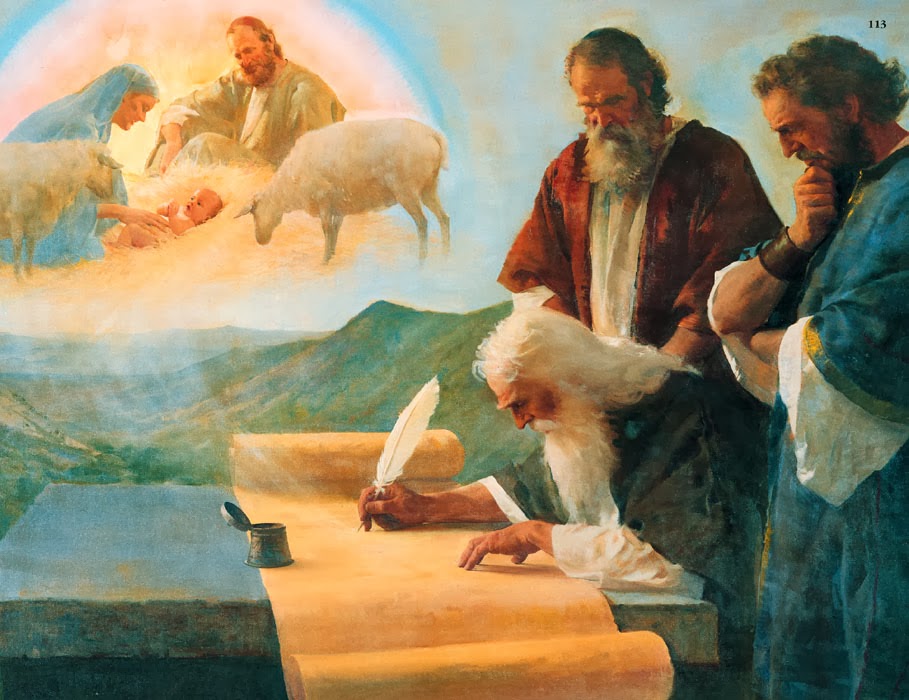 |
| Nephi and Lehi study the words of Isaiah which testify of Jesus Christ |
25 And there shall be upon every high mountain, and upon every high hill, rivers and streams of waters in the day of the great slaughter, when the towers fall.
Isaiah 30:25


