“The way a book is read — which is to say, the qualities a reader brings to a book — can have as much to do with its worth as anything the author puts into it…. Anyone who can read can learn how to read deeply and thus live more fully.”
~Norman Cousins


Writing is where we truly learn. Join the Journey.

I read from my scriptures (book), but you can find scripture reference here.
Showing posts with label scriptures. Show all posts

Thursday, October 3, 2013

Search, Ponder, Study the Scripture 1 Nephi 5, 19, 22; 2 Nephi 9, Omni, Jacob 4


 The great day of the Lord is near, it is near, and hasteth greatly, even the voice of the day of the Lord:
 the mighty man shall cry there bitterly.That day is a day of wrath, a day of trouble and distress, 
a day of wasteness and desolation, a day of darkness and gloominess, a day of clouds and thick darkness.  
A day of the trumpet and alarm against the fenced cities, and against the high towers.Zephaniah 1:14-16


The two towers fell and the destruction was great. I remember this day like no other because it had personal ramifications for my life. And afterwards while everyone was trying to figure out what it meant I remember my father’s words that this great event had been foretold by the prophets Isaiah and  Zephaniah. I remember picking my mouth up off the floor and not really understanding what he was trying to tell me? It was a defining moment for me - one when I knew I had to know for myself what it meant.  I had to have my own interpretation.  I had reached the point in my life, like Nephi, when prophesied destruction would not convince me.  I had to study it- for myself. (1 Nephi 11-16)


The scriptures are not just predictions of man’s doom, nor are they stories about his most unsavory mistakes. I have heard the Old Testament described as a lurid script for a common day soap opera. And while the descriptive sagas captivate our imaginations and help us to see the uglier side of mankind, their intended purpose is to warn and teach us of man’s need to reverence God and His commandments. They are meant to admonish us to live a holier more refined life filled with charity.

God's charity toward us can be found in the preservation of his word through scripture. The Bible is God's word that teaches us through story about man's past errs and triumphs. We have it because men of God obeyed his counsel and wrote it down.  The entire purpose of the Book of Mormon was to keep a record of Lehi’s family’s journey and relevance as a branch of the Israelites. It's testimony acts as a second witness to the Bible in declaring the sacred mission of our Lord and Savior Jesus Christ. Its entire purpose is to teach us the importance of studying the scriptures of God so that we might learn to work out our own salvation.

Every Book of Mormon prophet writes to not only record the truth of God’s love, but to also leave a witness to the divinity of Christ.  This divinity can best be learned through the study of the prophets written word; their purpose was to teach us to learn for ourselves through our own personal scripture study.

After sending his sons back to Jerusalem to retrieve the brass plates which contained the 1st five books of what we now know as the Old Testament, Lehi searches them and rejoices. In them he found his genealogy, the prophecies of all the prophets through to Jeremiah, Adam and Eve’s story, and the commandments of Moses.  Lehi prophesied that the plates would go forth to all nations, never perish or be dimmed by time, and rejoiced when he realized their worth:

  And we had obtained the records which the Lord had commanded us, and searched them and found that they were desirable; yea, even of great worth unto us, insomuch that we could preserve the commandments of the Lord unto our children.
1 Nephi 5:21

In 1 Nephi 19 Nephi has begun to read the “1st five books of Moses” and begins to share some of what he learns. He is instructed to become like the scribes of ancient Jerusalem and preserve his civilizations’ most precious truths upon plates of ore. He shares his readings with his brethren and in hopes of helping them understand Isaiah’s writings he teaches them that the best way to understand scripture is to liken it unto ourselves.  (1 N 19:23)

Like Nephi, Jacob, Enos, Omni, King Benjamin, Alma the Elder, Zeezrom, Ether, Mormon, and Moroni all encourage the personal reading and study of the scriptures.  From Abinadi we learn what happens to a culture that puts aside the commandments of Moses and do not teach them. Of all of these many examples my favorite comes from Omni and Mosiah 25.

Omni first tells us of people who settled and built up the land of Zarahemla. Mosiah had discovered the Mulekites when he heeded the counsel of the Lord and fleed to the land northward where he discovers the land of Zarahemla. This people had come, like Lehi’s people, from Jerusalem – only their saga began at the time King Zedekiah was carried away into Babylon. They too had traveled across the waters but they had not brought with them historical records of their people. Nor had they kept any records. 

Great was their rejoicing at their discovery of Mosiah’s people. They rejoiced because of the record of the Jews, the history that the people of Mosiah brought with them.

And they discovered a people, who were called the people of Zarahemla. Now, there was great rejoicing among the people of Zarahemla; and also Zarahemla did rejoice exceedingly, because the Lord had sent the people of Mosiah with the plates of brass which contained the record of the Jews.
Omni 1:14

And they rejoiced because of the interpreters they carried. While they had traveled in the wilderness they had come across another group of people who had, not withstanding their obedience in keeping a record, had not lived the word of God and had self destructed. The interpreters proved helpful in the translation of the Jaredite record and the understanding of how people who do not reverence the commandments of God make their own demise.

These Mulekites relished history. I guess it’s because they had lived without it. I call it the lesson of opposites. We value most what we do not have.

Mosiah 25 helps us understand how those who have been without the written word of history are affected by the written word. King Mosiah had caused that the Mulekites join with the Nephites and that a record of the people of Zeniff be read.  Zeniff was the father of King Noah. He had left Mosiah’s people and traveled down to his land of inheritance, the land of Nephi where the Lamanites dwelled. Mosiah had the account of Zeniff’s people, the martyrdom of Abinadi and Alma’s escape back to Zarahemla read to them:

And now, when Mosiah had made an end of reading the records, his people who tarried in the land were struck with wonder and amazement.
For they knew not what to think; for when they beheld those that had been delivered out of bondage they were filled with exceedingly great joy.
And again, when they thought of their brethren who had been slain by the Lamanites they were filled with sorrow, and even shed many tears of sorrow.
And again, when they thought of the immediate goodness of God, and his power in delivering Alma and his brethren out of the hands of the Lamanites and of bondage, they did raise their voices and give thanks to God.
And again, when they thought upon the Lamanites, who were their brethren, of their sinful and polluted state, they were filled with pain and anguish for the welfare of their souls.

Mosiah 25:7-11

In reading this I was struck with the powerful words of emotion used to describe their reactions: wonder, amazement, "they knew not what to think", many tears of sorrow, and pain and anguish for the welfare of their souls.

I think of how the two burning towers of New York City brought such great emotion. I thought how I too did not know what to think? For at this time I had not read nor had I understood the scriptures. I was filled with great joy for those of our countrymen who were delivered that day, and with great pain and anguish for those who perished and suffered.

And I want to always to be able to say that when I think of the immediate goodness of God, and his power in delivering me and my family out of the hands of those who would destroy my life and put me into bondage, that I will like the people of Mosiah and the Mulekites raise my voice and give thanks to God. For as I study God's word I learn of his love and dealings with man. I learn to recognize his hand in my life and I am amazed.
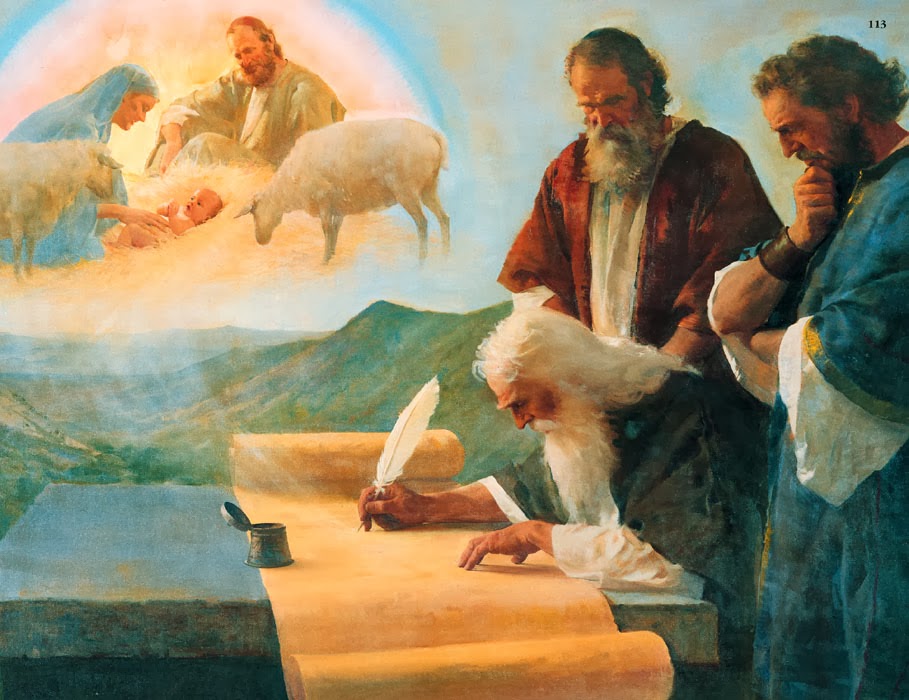

Nephi and Lehi study the words of Isaiah which testify of Jesus Christ

25 And there shall be upon every high mountain, and upon every high hill, rivers and streams of waters in the day of the great slaughter, when the towers fall.
Isaiah 30:25


Friday, January 25, 2013

Like Father Lehi 1 Nephi - 2 Nephi

Drawing by Chris White 


Everyday I see new evidence that the Lord loves us -Really loves us. He has promised that if we will ask, with sincerity, that he will never leave us alone and that he will protect us and guide us to our promised land -like he did Lehi. In my class tonight we discussed this very principle. We talked about prophets and how the Lord uses prophets to establish his Kingdom on the earth. We talked about Lehi and how we can be like Lehi. 

We learned that prophets teach us about spiritual truths, bear testimony of the divinity of Jesus Christ and write the word of God into what we call Holy Scripture. Through prophets we have the power and authority given to men to act in God's name for the salvation of his children -  the priesthood. They teach us wonderful patterns of behavior and principles of truth: like prayer, revelation, forgiveness, patience, temperance, etc. Prophets help us understand our relationship to God as we seek to obtain eternal life. The relationship between God and his prophets is a good one to model after. 

So I asked the class to read the first few books of Nephi and to look for Lehi's relationship with the Lord.  I found a few clues that I thought were pretty good, but as is usually the case when the spirit of God takes over the lesson, together we all found some that surprised us. And tonight the teacher became the student. 

Not a Prophet?
As a Jewish merchant and citizen of Jerusalem
Lehi listened to the many prophets as they
testified of Jerusalem's destruction. 
As we listed many of Lehi's roles and characteristics on the board, one sister said, "and he wasn't a prophet." I asked her why she believed this and she described very accurately how he had been listening to the prophets prophesy, so how could he be a prophet? Okay... I didn't see that before. So we read on and discovered that indeed, in the beginning of his story, before he left Jerusalem, he was a merchant, a father, a Jew, a citizen of Jerusalem, a student of Hebrew but he probably was not always a prophet. Wow. 

Called to be a prophet  
But he believed the prophets! That set him apart. And because he believed, he gained a conviction to follow the pattern that prophets follow. He had to ask. So (if) he wasn't a prophet in verse 5 when he knelt by the rock and prayed "with all of his heart, in behalf of his people," certainly by verse 6 when he beheld a pillar of fire, he was on his way. I don't know about you, but I have never seen a pillar of fire "dwell" before me on a rock when I prayed. I believe this was his calling. God needed him to do what only Lehi could do. He would be called in his dispensation to lead a nation to a promised land. 

                  
We talked about the unlikeliness of being called as a prophet. Don't think so. But still there are things that we are called to do that only we can do. Things that the Lord knows. So no matter who we think we are, our wealth, our station, our place in life, God made it plain to Lehi that he knew who Lehi was and that there was a work meant solely for Lehi to do. Are we any different? Does God not have a job for each of us? A job that only we can do that will change the course of our family's life?

Prayerful 
Prayer - sincere heartfelt prayer - can open the heavens. Lehi was so filled with the spirit of God because of all he heard and saw, in answer to his prayer, that he trembled. Soon he had to go home. When he got home he fell on his bed and had a vision.  His spirit had been touched by the truth of testimony and he had to know. He had to pray and ask for himself. And when he prayed he found out that God had a lot more in store for him than he might have thought. But mostly he found out that God loved him and that he didn't have to perish with all of Jerusalem. But .. he would have to share his new knowledge. and that's where life began to change for him and his family. 

Filled with the Spirit of Revelation 
At home he was thus so “overcome with the Spirit and the things which he had seen, that he was carried away into a "vision.” (vs7-8) While caught up in his vision in which he sees God and his apostles, he is given a book that foretells of Jerusalem's destruction. He rejoices that he will not have to be destroyed. Why? Because he knows the truth. And now that he knows the truth he can obediently follow God's spiritual direction that will lead him to a promised land.  

He thus had his confirmation of prophesy concerning the people and place that he had called home his entire life.

Later the Liahona is given to Lehi to direct their travels. Like a compass it worked strictly by the power of revelation and the Holy Spirit. When Lehi fails to ask God, the Liahona fails to work. Lehi was the only one who could use it. Not even Nephi could usurp his father in this calling as a prophet to interpret the direction his people were to travel.

Goodly Parent
Lets back it up a bit. Lehi was also a goodly parent, (1 Nephi 1:1) who taught his sons and particularly Nephi knowledge and  the culture and learning of the Jews through Egyptian Hebrew(1 N 1:2). He cared about the welfare of his family. He cared about the welfare of his neighbors. He questioned. He asked. He listened. He received. He educated his family and he worried about what would become of them. He was a father filled with great love and dedication to his family. Else why would he have prayed? If his heart was not set on the things of an eternal nature, why would he have cared?


Dreamer and Visionary- A Prophet 
So in our class we talked about what makes a prophet a prophet. Lehi had asked to know. And when he asked God gave him: a pillar of fire, the spirit of God, a vision, revelation, understanding, a book that filled him with the Spirit, dreams, and knowledge about how our actions affect the paths that we are on. There are many of us who dream but this does not make us a prophet. Dreams need the power of revelation to be interpreted in truth. As a literal descendent of Joseph of Egypt, his propensity for vision and dreams came naturally. 

Lehi's dreams and his visions give him guidance and strength in truth. Through his dreams and visions we learn of the tree of life, the dark and dreary wastelands, the large and spacious buildings, the iron rod, the book of life, God and his twelve apostles, the tender mercies of the Lord, the need to depart and travel towards the promised land, and many other truths.


Lehi accepted his call to be a prophet when he courageously shared all that he had learned with anyone who would hear. Even though they had stoned and killed the prophets before him, he was not afraid. He understood that the "tender mercies" would give him "the power of deliverance." (vs 20) The revealed truth of God is powerful. It moved Lehi to change. It moves us all to change. It is the basis for the gospel of Jesus Christ.     

Grateful 
Lehi reverenced God. His reverence for God and his omnipotent power is expressed in verse 14 and 15 when upon the realization of his Father’s love for him he extols his gratitude and praise upon God. He realizes God's love, power, goodness and mercy for him. He understands that God will not "suffer those who come unto 'him' that they shall perish." (1N1:14) As long as he gives all of his faith and obedience to God, God will protect him from destruction - destruction from stoning or from the destruction of Jerusalem. Who wouldn't be grateful at the realization of this source of eternal life?

Optimistic
It was pointed out to me that Lehi, through all of his difficulties in Jerusalem, in prophesying, in leading his family always looked forward to where they were going. He didn't get bogged down with where they had been, where they were, or the problems they faced. (Okay he did murmur once when Nephi broke his bow. He was hungry(1N1:6)) Lehi's constant communication with the Lord kept him happy and optimistic about life. (My favorite prophet has always been President Gordan B. Hinckley because he exuded the epitome of optimism.) Even before his death Lehi could only bless his children with positive words of hope and prosperity. He is a man who gives full credence tot he promises that God has given him. His seed - though they will have difficulty - will not be utterly destroyed because God had made him a promise. 


Faithful and Obedient -
The first thing he does upon leaving Jerusalem and setting up camp is to build an altar to God and offer sacrifice and worship. (1 N 2:1) Religious rites keep our minds and bodies obedient to the laws of heaven. Lehi shows his obedience in many ways. I have to believe that he, like Nephi, was also of goodly parents who taught him the importance of strict obedience and respect for God's higher laws. 

Compassion and Sorrow
Is it possible to have Godly mercy extended to you and you yourself not want to do the same for others? Lehi knew that all he had heard was true and he wanted to help protect those with whom he lived and did business with, those with whom he had grown old with and raised his family with. But he was mocked and “cast out” (vs 20). In 2 N 1:17 we learn that his heart was sorrowful for the fear that his family would be cut off and destroyed forever. I imagine it was difficult for him to learn that his children did not share his deep understanding of God's love. 

Family Problems
Even Sariah murmured and two of his sons were disrespectful and rude. Were they not taught like Nephi? Sariah called him a visionary man and complained, but Lehi comforted her. He did not rebuke her. He did not become frustrated and distraught, he comforted her. He was a good husband and a strong family leader. Why? Because he drew his strength from his undeniable faith in God.  Consider what he has asked Sariah to do? 
  • Leave the only home they had ever known. 
  • Leave their family and friends,
  • Leave their material possessions, wealth, clothing 
  • Bear at least two more sons in the wilderness, away from the strength of community
  • Travel to an unknown destination 
  • Make your sons return at the peril of their lives to retrieve a book of history
Now consider how he can convince her and his sons that this is the right thing to do. He has no visual aid, no map, no travel guide, no plan. He only has his faith in God and this is what he must use to comfort and lead his family. 

Scribe


Lehi wrote. (1N1:16) The Lord commanded him to write and keep records of all that he had seen and heard and bear testimony of it. His record known as the plates of Lehi were first given to Joseph Smith and were part of the original small plates of Nephi.  The information on these plates were very similar to accounts given in the other sections of the small plates of Nephi so that when Martin Harris looses these plates of Lehi, the Lord does not have Joseph Smith re-translate them. 
His words were lost to the world.  2430 years after he leaves Jerusalem, the Lord restores them as the Book of Mormon and they act as a second witness to Jeremiah, the prophet of his time. Though we do not have the actual words, Joseph Smith was told that the essence of their teachings were contained in the other books of Nephi. 


 Leader
He understood what would be needed for their trek in the wilderness to the promised land. He was not leaving for fear for his life. He was leaving because the Lord commanded him to so that the Lord might preserve him and his family.  As a leader of a family he knew that they would need more than food and water and shelter to survive. They would need hope of a better tomorrow. This would come from the brass plates that contained the record of the Jews ( or the 1st five books of the books of Moses  .ie. the Torah).

Leaders are not inherently strong, they receive strength from somewhere. Lehi's strength in leadership came from his deep understanding of scripture. Upon receiving the Brass plates, the first thing he does is to search them. (1 Neph 5:10.) Upon seeing the book in his vision, he reads it and is filled with the spirit of God.  As a leader he understood the power of positive reinforcement and he rehearses to his family the many things the Lord has done. (2N 1:1). He understood the need of physical provisions so he had his family pack seed of every kind. (1 N 8:1) He was humble and did not take credit for that which was God's. His humble submission to God's will gave him problem solving skills, insight, the ability to know the future, and how to comfort those whose faith was not like unto his own. 

Patriarch/Historian
As a patriarch he gave all of his children blessings, much like the tradition of Israel. As a historian and genealogist he recounted his family history to his children often. He understood the need for a people to have and share a common story. The rich culture of the plates of brass gave him a rich heritage from which to teach his children as well as the lineage of his family. I was surprised to realize that Lehi had most likely never read the fullness of the brass plates before. Even though Laban was his cousin, he had kept the plates but had not shared their significance nor their faith value. 

Lehi understood the need for the power of revelation. He understood that revelation begets revelation and that his ability to follow the Lord's guidance through the wilderness would require him to have the power of scripture. His life changed when he took that first step to listen, to learn, to live and to lead others to the gospel of Jesus Christ. 

We too can be like Lehi. We too can search the scriptures and harvest from them not just the stories but the power of revelation that lives within them. We too can accept the tender mercies of the Lord and receive the protection that comes to them that follow him.(1N1:20) We too can be like Lehi and find our own promises of the Lord. We can find our own promised land of truth and peace and prosperity. We can look for the patterns of the prophets, the peace that exudes from their words and their actions, and we can use the conviction of truth to change what needs to be changed in our own lives. 

Lehi has many notable characteristics. I am sure that others will find many more in the few verses that describe his relationship with God and his family. I am sure that as they do they will discover the power and wonder revelation brings into our lives. What a wonder it is that God loves us enough to call prophets who can see what we cannot. What a blessing it is to behold the Kingdom of God here on earth, to witness in the lives of those who testify. What a wonder God's love is to behold. 
Today I am thankful, like Lehi, for God's merciful love for me. And I too want to share. I want to try to be like the prophets that first inspired Lehi. I want to try to be like Father Lehi.

Friday, September 7, 2012

2 Nephi 2: 1-10 "In the Wilderness"


Colorado foothills outside of GreenRiver.
Wilderness: a tract of region uncultivated and uninhabited by human beings.an empty or pathless area or region wilderness; a part of a garden devoted to wild growth; a wild or uncultivated state of being; a confusing multitude or mass: a bewildering situation... wildernesses o civilized life - (Miriam Webster)

What a beautiful sunset in western Colorado! photo by LShaw


Almost there Day 4
Recently while on a cross country trip to return my daughter to university, we drove through the deserts of Texas, New Mexico and Colorado.  For two days we traversed mostly desolate state highways. I felt both elation and concern. While my soul stretched wide with the expansive skyscape, danced with the sun's streaming rays, and rolled with the solitary sagebrush that tumbled across the western skyline, I was very much aware that I was in a western wilderness.  Protected only by the sanctuary and reliability of our  Honda Accord, we paid attention to our surroundings.   It was around dusk when  at one rest area, I stepped to close the car door  and several birds swooped through and around the parking area, seemingly attacking our car? What was that? I didn't see that coming!  As if the startling experience wasn't enough, I then read a sign that warned, "Beware of Snakes". Ugh.. Needless to say as I utilized the restroom, I scanned the walls for spiders and scorpions and other unwanted poisonous guests. As we continued through this stretch of barren land we were careful to monitor our gas gauge, our bodily needs, and the functionality of our car. We did not want to find ourselves stranded in the wilderness. 


Sunset in south Colorado
Throughout history man's dialogue with nature has involved the wilderness.  The earth's natural history is interwoven within man's history of growth, independence and progress. Within the standard works of the scriptures the word is used 523 times. If you include the additional 447 times it occurs within "other" doctrinal materials, a pattern of its prevalence within our religious culture begins to emerge. From the time Adam left the garden the theme of parental protection against the wiles of wilderness has thread its way into our lives. Lehi's addresses his son as his "first-born in the days of my tribulation in the wilderness."(v.1) Why? 


Sunday, July 1, 2012

Genesis 22 A Lamb for an offering


When God asks us to sacrifice, he always provides a lamb in the bushes.
It's been a long week for me. A week of second guessing myself and choosing direction.  A week of travel, meetings, and family time that has caused me to wonder why I read and ponder and study the scriptures the way I do.  Why am I on this scripture journey? And that led me to consider if Abraham ever wondered why his love for God had brought him to the place where he was willing to listen to obedience and love for God over ethical reason, over family security?  His faith was so sure that he didn't know how God would answer his pleas, but he knew he had to obey, and that his answer would come in and through his obedience. In practicing obedience he would find the answers and understanding of God's law that he longed for.  God had kept his promise before, why would God forsake him now? He didn't know where the Lamb for an offering would come from, but surely as he prepared and did all that God required of him, he knew that the lamb would be there. He trusted God. And in trusting God, he learned to trust himself. God knew how Abraham would respond. The test was for Abraham to learn how Abraham would respond. 

Concerning Abraham, President Hugh B. Brown said,  

"God commanded Abraham to sacrifice Isaac because "Abraham needed to learn something about Abraham" (in Truman G. Madsen, The Highest in Us [1978], 49). 
Elder George Q. Cannon spoke about Abraham in the April 1899 Conference. He said: 


“Why did the Lord ask such things of Abraham? Because, knowing what his future would be and that he would be the father of an innumerable posterity, he was determined to test him. God did not do this for His own sake; for He knew by His foreknowledge what Abraham would do; but the purpose was to impress upon Abraham a lesson, and to enable him to attain unto knowledge that he could not obtain in any other way. That is why God tries all of us. It is not for His own knowledge; for He knows all things beforehand. He knows all your lives and everything you will do. But He tries us for our own good, that we may know ourselves. ... He required Abraham to submit to this trial because He intended to give him glory, exaltation and honor; He intended to make him a king and a priest, to share with Himself the glory, power and dominion which He exercised” (GeorgeQ. Cannon, in Conference Report, Apr. 1899, 66).


Sometimes it feels like when I sit down to write I am listening to obedience over reason. I don't have a clue how many people I am reaching?   Do my words matter? Is it a wise use of my time, my faith? But I know, like Abraham,  that God is reaching me: one person, one mother, one daughter, one sister, one grandmother, one handmaiden of the Lord, one family.  When there are so many other things I can with my time I wonder why I write so deeply about what I learn? The beauty is that every time I write... every time I am obedient to the promptings to analyze and present my thoughts on the scriptures, I find "a lamb" in the bushes, some surprise that God has prepared for me that I would not have seen if I had chosen to disobey. Usually it comes in a learned principal that raises my spirit up, or stabilizes the ground I stand on. Or it might teach me a new perspective that becomes imperative in my own families peril of survival, but not always. Sometimes it merely brings me peace. A peace that I am certain Abraham felt when he realized where his loyalties lay and the rewards that his faith would bring him and all of his likewise obedient progeny. 
The sister missionaries in my daughters mission


I have a daughter who is currently on a mission for our church. Her leaders have kept a mission blog and I read it from time to time. Tonight when I read through it I was amazed at how much sacrifice is given by each missionary and by each leader. There is one photo of the mission president and his wife washing dishes. Mission Presidents come from all walks of life: wealthy, poor, educated, not so educated, successful businessmen, farmers, sportsmen, educators, etc. When they come to serve the Lord they come to serve. The only prerequisite they need is a willing heart to sacrifice what or whom they love so that others can learn and feel of God's love.  Fortunately the law of blood sacrifice passed with the atonement by Jesus Christ. God now proves us by asking us to present our willingness to serve and love one another. It starts in our family with our spouse, our children, our parents and then moves to our neighbors our church community, our school or city of residence. We are asked to forsake selfish pleasures and desires for the welfare of something larger than ourself.  When we do this we find .... our own joys.  But mostly.. we find ourself. We discover what we hold dear. Each choice to serve and obey defines us. It draws us into the circle of God's love. 


It's not because God needs to know who we are and what we are capable of, it's because like Abraham who was given a commandment to sacrifice the very thing he had lived his entire life for, the very promise that God had given him, we are brought to our own personal trials so that we too might know where our loyalties and our joys lie. 


I have found that when I read and contemplate the scriptures each week, I am able to make my relationship with him more active. No longer am I a passive receiver of words.  By writing what I learn the lessons become imprinted on my heart and act as a guiding star in my daily decisions. How often have I considered Sarah and Abraham and their love for one another, their epic story of love, fidelity, faith, and what they sacrificed for me so that I might have a higher understanding of God's law. How grateful I am to my friend who challenged me a year ago to read Genesis. Never in my wild imaginations could I have conceived how profoundly this book of holy scripture would forever change me. By making a consistent effort to commit to feast on his words I have found great peace and comfort in my trials. I have learned to let anxiety pass me by and understood better what it means to trust in the Lord with all my heart, might, mind and strength. I have not known fewer trials, but I have had the strength to use my trials as stepping stones. And isn't it true that with each trial we face if we don't make it into a stepping stone, it becomes a stumbling stone that stresses us and causes us to loose our way. 


Concerning the stress and trials that Abraham went through to discover these truths Elder Neal A. Maxwell  said our lives “cannot be both faith-filled and stress-free....
“Therefore, how can you and I really expect to glide naively through life, as if to say, Lord, give me experience, but not grief, not sorrow, not pain, not opposition, not betrayal, and certainly not to be forsaken. Keep from me, Lord, all those experiences which made Thee what Thou art! Then let me come and dwell with Thee and fully share Thy joy!” (in Conference Report, Apr. 1991, 117; or Ensign, May 1991, 88 ).
Most focus in Genesis 22 is on  the fact that he is offering his son, that he has ignored the moral law of not killing your own, that it goes against everything God had taught him, or that it is just so horrible to consider that he would give his son. We focus on Isaac and his grief and pain. Abraham's sacrifice is hard to consider because Abraham's trial is our own. It is why we have a hard time pondering it. It is the sacrifice we forsake to serve another, to stand as a witness, to show God and ourself that the love within us is the love we believe it is. 


Sunday, August 22, 2010

Dear God (Helaman10: 6-19)


Helaman 10: 6-19


Dear God..
(to understand a prophet I went to the counsel of the living prophets)


I read your scripture today and I did not understand it. I tried to but it seems to be beyond anything that I can comprehend. I could never imagine that you would trust me enough to give me so much power as you did Nephi. I could never imagine that I could smite the earth with famine or that I would want to? I understand the need to discipline and to help those I love through "tough love" by being strict, firm and strong, but I don't believe I could ever be a Nephi.
But wait. Nephi was a prophet. He spoke with you often and you spoke with him. You and he had a great understanding of one another. I don't believe I could ever find anything in these scriptures that would liken me to them? Could I?


Words and Phrases


vs 6 thou art Nephi and I am God..... I see two seperate beings here. I see a God and a follower of God, a son of God, a true believer, a disciple. A prophet made so pure by his faith that he was able to earn the trust of God.

vs 7 I give unto you power... When has God ever given me power? I am a mother. I have been given God's power to co create and raise souls unto joy. I am a woman and I have been given the power to heal and to love those in need of loving. I am a daughter and I have been given the power to see the vision of my father's faith. I am a sister and I have been given the power to build up and love the siblings of my youth. I am a Saint of God and I have been given the power to help others understand his love, his faith and his path.

vs 7 I give unto you power..to seal.. I am the maker of hearts and I can seal my heart to God's by my faith. I can seal my love to my family by my actions. I can seal my acts of kindness to those in need of his love.

Helaman 10:7 whatsoever ye shall seal on earth shall be sealed in heaven
Joseph Smith

“The doctrine or sealing power of Elijah is as follows: If you have power to seal on earth and in heaven, then we should be wise. The first thing you do, go and seal on earth your sons and daughters unto yourself, and yourself unto your fathers in eternal glory, and go ahead, and not go back, but use a little wisdom, and seal all you can, and when you get to heaven tell your Father that what you seal on earth should be sealed in heaven, according to his promise. I will walk through the gate of heaven and claim what I seal, and those that follow me and my counsel.” (Teachings of the Prophet Joseph Smith, p. 340)
Boyd K. Packer
“That sacred sealing power is with the Church now. Nothing is regarded with more sacred contemplation by those who know the significance of this authority. Nothing is more closely held. There are relatively few men who have been delegated this sealing power upon the earth at any given time—in each temple are brethren who have been given the sealing power. No one can get it except from the prophet, seer, and revelator and President of The Church of Jesus Christ of Latter-day Saints.
“A clear statement follows regarding the sealing power as binding on all that we do for the living and the dead.
“’Whenever the fulness of the gospel is on earth, the Lord has agents to whom he gives power to bind on earth and seal eternally in the heavens (Matt. 16:19; Matt. 18:18; Hel. 10:3-10; D&C 132:46-49.)
“’All things that are not sealed by this power have an end when men are dead. Unless a baptism has this enduring seal, it will not admit a person to the celestial kingdom; unless an eternal marriage covenant is sealed by this authority, it will not take the participating parties to an exaltation in the highest heaven within the celestial world.
“’All things gain enduring force and validity because of the sealing power. So comprehensive is this power that it embraces ordinances performed for the living and the dead, seals the children on earth up to their fathers who went before, and forms the enduring patriarchal chain that will exist eternally among exalted beings’ (Bruce R. McConkie, Mormon Doctrine, 2d ed., Salt Lake City: Bookcraft, 1966, p. 683).
“In the Church we hold sufficient authority to perform all of the ordinances necessary to redeem and to exalt the whole human family. And, because we have the keys to the sealing power, what we bind in proper order here will be bound in heaven. Those keys—the keys to seal and bind on earth, and have it bound in heaven—represent the consummate gift from our God. With that authority we can baptize and bless, we can endow and seal, and the Lord will honor our commitments.” (Ensign, Feb. 1995, p. 32)
vs 16 he was taken by the spirit .. did Nephi die. Was he translated? Does anyone know the meaning of this verse? I do not know. What is more perplexing is when it is read in conjuction with ...
Helaman 10:16 he was taken by the Spirit and conveyed away out of the midst of them
Bruce R. McConkie

“Other prophets had been and would be transported bodily from place to place by the power of the Spirit. Ezekiel was lifted up and carried by the Spirit. (Ezek. 8:2-3.) Nephi ‘was caught away in the Spirit of the Lord, yea, into an exceeding high mountain,’ upon which he ‘never had before’ set his ‘foot.’ (1 Ne. 11:1.) Mary herself ‘was carried away in the Spirit’ at the time of the conception of Jesus. (1 Ne. 11:19-21.) Nephi the son of Helaman ‘was taken by the Spirit and conveyed away out of the midst’ of those who sought to imprison him, and thus ‘he did go forth in the Spirit, from multitude to multitude, declaring the word of God.’ (Hel. 10:16-17.) After Philip baptized the eunuch, ‘the Spirit of the Lord caught [him] away,’ and he was carried to Azotus. (Acts 8:39-40.) It is not an unheard-of thing for the Lord, by the power of the Spirit, to transport mortals from place to place…” (The Mortal Messiah¸ p. 413)
vs 17 he did go forth in the spirit-
vs 18 there began to be contentions-

Richard G. Scott

"The Book of Mormon then teaches a most impressive lesson concerning how we can learn truth: ‘And it came to pass that Nephi went his way towards his own house, pondering upon the things which the Lord had shown unto him’ (Helaman 10:2). As is characteristically the case, that pondering opened a channel of communication that brought additional understanding and truth to Nephi. In this particular instance, because of Nephi’s valiant testimony it allowed the Lord to confer upon him the sealing power. He later used that power to bring many of the Nephites and Lamanites to repentance and salvation.” (Heroes From The Book of Mormon, p. 152)
Gordon B. Hinckley

We all do a lot of studying, but most of us don’t do much meditation. We don’t take time to think. I’d like to suggest that next fast day . . . everybody in this hall set aside an hour or two. Sit by yourself. Go in the bedroom and lock the door. Go out in the yard under a tree. Go in your study if you have one and shut the door, and think about yourself and your worthiness. Read from this great book [Book of Mormon]…There’s a great word that’s used, ‘ponder.’
“’Ponder.’ What do we mean by ‘ponder’? Well, I think it simply means kind of quietly thinking things through. Ponder what you have read. Ponder your life. Are you worthy, are you living the commandments…?” (Church News, 01/06/96)

Monday, May 24, 2010

Introduction

I call this blog.. "In My days", a scriptural journey through the scriptures. I recently read the scriptures and found a new joy and strength that comes from them. I want to share these strengths with those who care to hear. I want to have the opportunity to share the scriptures from my point of view. Hopefully others will benefit.
I remember the first time I read the scriptures. The Bible lost me in its archaic language. I don't, however believe that we should change the words to help us understand, we should rather change ourselves. The spirit of the Lord works within us and helps us see the hidden meanings. The spirt of the Lord helps open our eyes and our hearts so that we might hear and know the Lord's word as it pertains to our lives.
These insights are my insights. The scriptures were meant to be likened unto ourselves "1 Nephi 19:23". This just means that when we read them, we are to ask, how does that fit into my life? or, How could I see myself? Or where in this verse could I put my life? By doing this we are able to really internalize the words of wisdom and see how they can truly help guide us in our path of life.
If I say something that inspires or helps you, I hope that you will comment. If I say something that you disagree with please feel free to comment, but do so kindly. These words are written out of "goodly intent". You don't have to believe them, but you don't need to argue them either. These words represent my views as I travel on my journey in life. You are free to choose as you believe, as I am free to believe as I believe.
It is my hope that they will be a strength to someone. I will begin with the Book of Mormon. It is Another Testament of our Lord and Savior Jesus Christ. I will move next to the Old and then New Testament. and finally through to the Doctrine and Covenants. I will cover some chapters one at a time, and other chapters will take longer. I will use all four sets of scriptures as references.
Related Posts with Thumbnails