“The way a book is read — which is to say, the qualities a reader brings to a book — can have as much to do with its worth as anything the author puts into it…. Anyone who can read can learn how to read deeply and thus live more fully.”
~Norman Cousins


Writing is where we truly learn. Join the Journey.

I read from my scriptures (book), but you can find scripture reference here.

Wednesday, September 9, 2015

Charity and the Apostles 1 Corinthians 11-16


1 Corinthians 11-16

In the past few months I have taken the challenge to read and reread the words of our modern day Apostles.  For a few of the prized quotes I used some of my photos to create image meme’s that help to share the deep emotion their words bring.

My quest began with the April 2015 General Conference addresses. As I pondered the varied topics and realized that not one of these men are assigned the topic of their talks but rather speak from their own hearts, my love for these men began to grow. For the first time I saw them as men whose lives have not been without tribulation but rather have been given in service, sacrifice and as examples to the rest of us as how to live in this dispensation of gospel time, how to live midst the trial and difficulties we must all face. 
 
The Apostle Paul who lived almost two thousand years ago said it best,
            
 “ Be ye followers of me, even as I also am of Christ.”

These men have chosen to be followers of Christ. Their actions, their service, their leadership of family, and their lives of integrity reflect their high moral characters and the true desires of their hearts.  While many of the topics of their talks are universally pertinent, a few could not be found in the indexes of our sacred scripture. Topics such as social media or “The Proclamation on the Family” are distinct to our social time.   As I read their words, my hope returned and I saw that if they could learn to serve our Savior through all of their trials then I could, in this time and place, do the same. While I revere the testimony of the many ancient prophets and their words will forever ring true, the words of the modern day prophets give needed direction for the choices we face in our day and time.

When Paul spoke to the Corinthians, it was if he was speaking at a General Conference. He spoke on the topics that were pertinent to the church during his time. He spoke of the need to preserve marriage (11:3-15), of the accepted length of a woman's hair, reverencing the sacrament ( 11:20-30), of Spiritual gifts (12-14) and of the resurrection.

This past weekend we had the privilege of visiting our daughter’s congregation where she, as the Sunday School Teacher, taught a beautiful lesson. She grabbed the class’s attention by asking what topics of discussion had been covered at the last General Conference of the church and comparing Paul's teachings in Corinthians to a General Conference.  As the class responded I pondered all of the topics I had studied. The list was long and varied.


And I began to marvel at how the Lord in his infinite wisdom has drawn on the diversity of the church to feed and reach those members who seek his love. I thought if only the Prophet had spoken, we would have only learned about temples and the priesthood. No doubt these are pertinent subjects but how many more souls were lifted up by being able to hear about the Young Adults, or integrity, or Elder Teixeira’s talk on  "Seeking the Lord" amidst the myriads of social media distractions. I am always amazed at how at least one or two talks seem to be directed at my life and serve to answer to the  difficulties I am facing.

My daughter’s genuine smile is large and contagious. As she led our class through the many lessons of Paul she kept reminding us of the upcoming October conference and how once again we will have the privilege of hearing wise words of our Apostles meant for our day. As she taught I felt her joy for the gospel and I felt gratitude for the grace of God that we have such a church which gives us not only instruction for our day, but opportunities for growth and learning. 

I truly felt God’s charity for me and my family. As I enjoyed the lengthy class discussion on charity and the many other gifts of the spirit, I found a renewal of my faith to seek charity within myself and share it with others in my family and social circles.

Paul’s words on charity remind us that of all the gifts this is the most prized. Why?
It has to do with how charity changes both the giver and the receiver. While the gift of tongues bridges cultural communication gaps, it cannot change hearts the way charity can. And while some are given to wisdom and others knowledge, miracles, or prophecy all of these call attention to the bearer of the gift, but charity alone gives back what it receives and bonds the giver to the receiver. Still, all gifts, like all parts of the body are needed.

I love to think about how charity brings us closer to God, for we truly cannot have charity without having a relationship with God. We need God’s love to help us suffer long, to be kind, especially in difficult or negative relationships, to find contentment in our possessions and social situations, to not puff ourselves up. Charity teaches us to be humble and to be strong in the midst of provocation. It teaches us to think only good, even when evil is present. We may recognize the evil, but we choose to think only good.


Charity rejoices in truth and through the power of he atonement learns to bear all things, believe all things, hope all things, and endure all things.

Paul goes on to say that prophecies and tongues, and knowledge may cease but charity never faileth. 

And that is when I realized that from the Apostles at General Conference I found charity. Charity for my weakness for they have had to live through their own. Charity for my lack of knowledge for I am still a toddler in the gospel. Charity for my wisdom for I err in my judgment often. Charity is the gift that the Lord Jesus Christ gives us when he instructs and nurtures us. 
 

Now as we begin to prepare for yet another conference of topics that come from the heart of these chosen men of God, I will look for answers to my prayers that these men will speak to our day yet again. And that they will borrow from the wisdom of the ages and the experience of this day and age and give me the guidance to help me follow them, even as they follow Christ.


Monday, May 11, 2015

"Because I drew him out of the water" Exodus 1-2 Moses' mother Jochebed

Jochabed and Miriam send Moses Off 


Yesterday was mother's day. I was able to spend it with my Mother, in her 83rd year and feel grateful for the joy that she has given me. On Saturday, I drove her to the store, purchased seed and flowers and planted her a garden, and then helped her shop for food. Sunday I drove her to church and afterward we, with my husband enjoyed a delicious meal together.  Afterward as we walked by the water's edge near her home together we felt peace and joy.

Through the years she has protected me from the world. She has fed, loved and instructed me, placed limits on me, given me opportunity to play and grow and learn, and all she has asked in return is my love and respect, plus some shared moments  of time here and there.  A little more time as she matures and her body slowly fails her. Time is my gift of love to her. Time is the greatest gift.

Is she perfect? No. Is she humble about her imperfections. Not really.  Does she still have her wit and humor? Yes, delightfully so.  Does she try to make my life better? Always. Has she always done the best that she knew how? Yes. Does the life she has lived teach me to live by faith? Most assuredly.

Motherhood gives us the gift of time. Time to learn, to grow, to mature, to become. It gives us the gift of living water that comes from faith in the Lord Jesus Christ.

I am thinking now of Moses' mother. I have never really thought of her before. I knew what she did to save Moses, but when you put it all into perspective, it is really amazing what she did and why?

Of the house of Levi, Jochebed had migrated with Jacob's family to Egypt. She knew the pharaoh's decree to kill all of the male children, to destroy the Hebrew family. She knew of his fear that the Hebrews would grow so numerous that they would threaten the Egyptian culture. Still, She, Moses' mother, feared God more.

She feared God more than Egypt, more than the soldiers who would have surely killed her if she had been caught. She feared God and chose to help her son live. She chose faith over fear. She needed time to ensure his safety and time to listen to God's love as it taught her what to do, so:
  • She saw that he was a goodly child
  • She hid him three months 
  • She made an ark (a boat) of bulrushes 
  • She coated it with slime and pitch
  • She put the child in it 
  • She put the ark near the river's edge
  • She pushed it towards the Pharaoh's daughter who was bathing 
  • She set her daughter Miriam to be near by
  • She had Miriam arrange for the Pharaoh's daughter to hire her for pay to nurse her own son. 

With God's help, Jochebed devised a plan. With faith in God she knew that she would not be killing her son, nor allow others to do so. She employed her mother's love to conquer the fear that ruled the day.

Not only did she want to protect him from the world that would drown him in the river Nile, she also desired to carve out a place where Egypt and the world could see his worth and learn to revere his life, his family, his culture, and his God.

Jochebed both created life and crafted life. By faith she released him into the water and by faith she prayed him drawn out again. She defied the Egyptian laws, she defied the midwives orders, she defied the lack of compassion in a world gone mad,  and she prayed in faith for guidance. She prayed in faith for hope in a plan that would save her son and her family. 

What did she rely on? The rules of men? No. The rational of men that lived in fear? No. Jochebed relied on compassion. Compassion born of faith and inherent to women. Compassion for the gift of life and for a better way. Compassion that does not live by rules but rather by the hope for emotional security.  

The Pharaoh's daughter was not alone when she discovered the ark in the bulrushes. She was with her handmaid's, who knew of the command of her father. And because her party was without the presence of men, she was empowered to choose compassion over obedience.  Men might have been strict to the law, they might have denied her the right to exercise her compassion. Driven by compliance to the Pharaoh's edict, a man would have seen the child with different eyes.  A mother's love is eternal.

The maids drew Moses from the water and Miriam, who watched nearby to both protect her brother and aid her mother's plan, came quickly to disclose that she knew of a Hebrew woman who had recently given birth, but was without child and could nurse the child. She had sent Miriam to guide the ark, to watch over. Another part of her plan to protect him, like she had protected him with pitch.

Why did she put pitch on Moses' ark? To protect him from the water that would cause the small boat to sink. The pitch kept the water out and Moses dry. What does this mean metaphorically? The pitch that Jochebed used to cover the ark that she would place her son in can be likened unto the love and faith that she was exhibiting in sending this child forth into the waters. She knew she could not keep him, for as he grew he would certainly be discovered, but she could protect him with her love, her faith, her good works, her songs and her craftsmanship, and then, once protected send him forth and rely on God's love to continue what she had begun. The pitch both protected him physically and spiritually.  

And it worked. Her foundation of faith that God would protect her son worked to not only save his life but the lives of all of the Hebrews whom he delivered from captivity eighty years later. 

The faith of a mother. What she will not do to stand between the evil that will destroy her child and the living water that will deliver him. How diligently she will pray and problem solve. So great was Jochebed's love that she would have, if needed given her own life.

For every day that she kept him alive was not her life in peril? For every day that his voice grew within him and he cooed in comfort and cried in hunger was not her life and the life of her family in peril? Yet she did this for three months. Each day praying for one more day before the day she must let him go. Praying for a plan that would ensure his survival in a world that certainly wanted him dead. 

And think of her plan to save him, was it not born of God's love for both her and the Hebrew nation?  Would a realistic plan have encouraged the hiding of her son in the household of those whom wanted him dead? Only the Pharaoh's daughter could convince her father to allow the child to live. Only the Pharaoh's daughter would pay Jochebed a wage to nurse her own son. Did the Pharaoh's daughter know the bond between mother and child? I think so, for true compassion can never be naive, but requires an eye of empathy. 

I wonder what Jochobed knew of the Pharaoh's household? Were his wives allowed to bear children? Was it a house of faith or one of desperation? How well did she know the goings on within the palace that she knew to send her son into this home? What faith she must have had to do such a thing. 
And the surprise of course is that because of Moses being raised within the household of the pharaoh as his adopted son, he knew the governmental weakness and he alone was the one who could stand before him and declare the Lord's command, "Let my people go." 

Moses' name means "drawn from the water".  And it is too the water that many people go to renew themselves, to cleanse themselves, and to find peace and answer.  Consider how Jochebed sent him into the water. Think how and why the Pharaoh's daughter visited the water edge: to find peace, to give peace, to pray, to seek answer.   Think how she she sent Miriam to stand within the water, and how Moses not only came from the water, but because of a mother's faith in the living water of our Savior, Jesus Christ was saved not from the water but because of the water.

I am grateful to all mothers that do for their children what Jochebed did for Moses. For those who must give their child up for adoption, for those who do not but strive all of their lives to place pitch in their child's boat before they send them out upon the waters of life, so that they like Moses might be drawn from the waters to save not just himself but all of his family.


Tuesday, September 9, 2014

Safety and Security in Covenants Mosiah 18:10


Penny is waiting for me as we take a walk through the back woods near our home.
The fall color has begun to paint itself upon the landscape. Nov 2013
I’m sitting in my writing chair. My walking companion of nearly twelve years now is tucked in close beside me, her long red nose, peppered with white is resting on my knee. She is patiently waiting for me to rise from my morning scripture time to walk with her.  I’m sure she is dreaming about the scent of rabbits or the adventure of a chase. Every now and again her deep restful breathing will change and she will raise her head and sigh deeply as if to say, “I’m here, but can we go yet?” I have promised to walk her, she has promised to make sure I get my exercise and to protect me. 

Her presence comforts me. I am aware of the safety in her friendship and as I watch her warm body rising and falling to the rhythm of life, I am reminded of her loyal companionship. As long as her mortal body will allow, she will not leave my side. She will come to me daily for love and to remind me of my daily need for friendship.  Her role in our family is to offer not only love but also protection. 

Now I reach my long fingers behind her ears and scratch them until her ears flop loosely atop her head. As I read I let my fingers move in circles on her shoulders. I hear her audible sigh of contentment.  There is a level of trust and understanding that exists between us. She helps me see how good friendships bring safety, how loyalty is love, and how trust is security.  

So I begin to think about the scriptures and what they bring to me. I begin to think about friendships and how good friendships and family ties bring me safety and security. I begin to see that each of us wants this from life, safety in our relationships with one another, the ideal that we can enjoy peace and loyalty in our friendships.

As I read my scriptures I was reminded about Abraham and how fearful life was for him. Wanting not only security from the lack of civility in a lawless and fearsome world, Abraham sought peace through the covenants of Lord. He sought to have a family that followed the counsel and laws of God. Nephi, who understood and lived by the covenants of Abraham wanted all of his family to feel of this safety, but he too had to leave the land of his inheritance to flee from his brother’ hatred. It seems that security cannot be found in the selfish ways of the world, but must first come in understanding the laws of God.

It’s time for me to rise and exercise my body. My dog loves the idea and now sits ready at the door, waiting for me to put my shoes on, to gather her leash and to fulfill my promise to her.

I realize that family is about promises. Promises we make with God, who is our measure of integrity and promises we make to one another. But of what use is the promise to one another if we love not God. If we love money, or idols or fame or any other fleeting promise what safety is secure?


That is why I walk my dog, because she has trusted me to love her and her love brings safety and security to my long day ahead. That too is why I read the words of God’s holy prophets, because they too bring an eternal perspective to the safety and security of my day. They help me understand the eternal importance of my family and the security and strength that their presence brings to my existence

.Mosiah 18: 10  Now I say unto you, if this be the desire of your hearts, what have you against being baptized in the name of the Lord, as a witness before him that ye have entered into a covenant with him, that ye will serve him and keep his commandments, that he may pour out his Spirit more abundantly upon you?

Gratitude 1 Thessalonians 5:18


I love sunsets.Do you know what makes a beautiful sunset? Clouds. The darkest clouds bring the most vibrant of color. I like to think that sunsets are how God takes the conflicts and the darkest moments of our day and frames them with his divine light. We first think that the day is ending but in reality if we follow the color,, the color that is created by the reflection of the sun's rays, His sun, it will lead us into another glorious day of brightness and hope. I like to think that a beautiful sunset, bathed in deep reds and oranges, framed by majestic hues of purple is not and ending, but God's way of reflecting his love across the horizon of all of our tomorrows. 


Tuesday, April 1, 2014

In our bodies we shall see God. 2 Nephi 9


I pulled the dripping green wand upward from the small plastic bottle, puckered my lips and blew. Oodles of bubbles swam dreamily through the air between my thirteen month old grandson and I.  I watched as his face froze in amazement. He gasped and then his little voice began to trill a series of staccato giggles.  I’m not sure who was more amazed, he or I?  I saw him tremble with delight and then stomp his feet.  As his giggles grew louder, the sounds of his pleasure soon filled the room with raw delight.
Just a few moments before, while searching for something to ward off his boredom, I had discovered the unopened bottle of bubbles. I   He was both amazed and bewildered, over-joyed and mystified, happy for the opportunity to touch one, so round and shiny and new, and then sad when with a barely audible pop they disappeared.  By touching the fingertips of both of his hands together, he signed his desire, “more, more”.  I laughed and laughed and then took another breath and blew.

I had not realized that this was the first time he had seen bubbles. He took queue from our dogs Penny and Hobbes and began trying first to touch them and then to eat. 
Bubbles.  They are something to behold aren’t they? They are magical, light, and beautiful. They swim through the air, and in the right circumstances we can both see, hold and dance with them. They are transparent, wet, colorful mirrors of the air around us.  
And they fill us with wonder. They remind us that we need our bodies to experience joy.

Watching my young grandson experience joy for the first time helped me recognize on a deeper level, the purpose of our bodies. I see my grandson explore, touch, think, ponder, and reach for every new experience that his parents and grandparents will allow. I watch daily as his language, physical strength, and love for all of his surroundings grows. And I consider the time I have here on earth.

Jacob taught the people about their time on earth and how they too could experience not just a fleeting joy but also a more eternal joy. He says that he has read the words of Isaiah so that they might know of the covenants of God and understand that because of God’s great love for us, he wants to bless us so that when we die we will see Him.  He wants them to understand that our bodies are our connection to God and to eternal joy. He spoke about spiritual laws that bind us to heaven and to earth.  He taught, “In our bodies we shall see God.”(vs 4)

When I read these verses for the umpteenth time… I’ve read it, I’ve been taught it in Sunday school, I’ve probably even taught it, … this time I had to stop and consider that I’ve never considered that for all those who have passed on, for all of my deceased family members, the plan of salvation allows them to stand on the day of their judgment in a resurrected body.  I had to think about this because in my mind I have this picture of my body remaining in the earth. I had to question? … How many resurrected beings do I know? And remember that all of the prophets of Jesus Christ have taught that in our bodies we shall see God.

So I considered this marvelous chapter in 2 Nephi and I read about the plan for those who have not known God and I read about those who know God and rebel. And for all of them..  they shall see God in their bodies. As I read I considered my grandson’s joy and I considered how important our bodies are!

These verses helped me realize the importance of bodies, of temple work for those who are separated from their bodies, and for missionary work.  And, it made me love my body more.

It means that the temple work we do is so that when they stand before God, they will have the opportunity to stand within a clean body: one that has been baptized and given the opportunity to utilize the power of the Holy Ghost.

Resurrection is for every body. It is for all who have lived on the earth or who will ever live on the earth. It is part of God’s great plan of happiness. If we are resurrected back into our bodies, now is the time for us to learn to love our bodies and accept them as the gift that they are.

I love my body. It is not as thin as the models on the tabloid magazines, but it is healthy. I cannot eat all that the world would tempt me with for it does not bounce back from glutinousness bouts of frenzied eating, but I can still enjoy the aroma and tastes of cinnamon apples. When I look into the mirror the image no longer reflects a youthful smile, but it walks gracefully beside my eternal companion.  As I have aged it has continually increased my bodily limitations: it does not run without pain, it requires and I mean requires eight hours of regular sleep, though it still enjoys exercise it rebels at the mention of excessive exercise, it creaks in new places and causes me to slow down even when my mind wants to move, move, move. But as the years have progressed, I have learned to love my body more.

Having a body… what was the Lord thinking? Consider how all that we know comes from our body: the sweet smell of lilac on a spring day or the sound of a rhythmic rain storm, the way colors magically turn into happiness, the way a tender touch upon our arm warms our heart and how when we reach out to hold a loved ones hands it connects generations, and the way well prepared foods burst their flavors into memories.  Joy comes to us because of our bodies. 

When our spirits learn to appreciate all that our bodies offer as testimony to God’s love, we then begin to open up to the possibility of eternal joy.


Monday, March 3, 2014

"Look unto the rock from whence ye are hewn" 2 Nephi 8 Isaiah 51,52

Our rock is strong and steady. It casts upon our world the light of  God's law. 
Yesterday I received an email from my brother. His grandson had become very ill and was not responding to traditional treatment. His email requested that our family include his family members (grandson and parents) in our prayers and because it was the first Sunday of the month, also in our family fast.

My brother was looking unto the rock from when we were all hewn. Our family has great strength because of our testimony in the Lord Jesus Christ. He understood that our combined faith could only add strength to his own. His email and this reading from 2 Nephi 8 made me reflect on our families rock.

One line is nearly 100 % Scottish and as such as given us the strength through a culture that values friendships and faith. My Grandmother Conkey was a woman that used her great moral authority to be a powerful force in the community. When I think of her and look to her example, my resolve to do more, to do better is strengthened.  I am reminded of how she "knew righteousness," and how the Lord had written his law upon her heart. (vs7) She never feared the reproach of men nor was she afraid of their reviling(s). (vs 7) Instead, she led the efforts to build a State Park, to improve her small farm community, and to encourage her husband to run for public office. In a day and time when women did not have many educational opportunities, she formed a women's social group that met solely to improve their lives through education.  She also helped others in need and through her smile and love for each of us, instilled a bright "gladness and joy."


My Grandfather Conkey's line, also nearly 80% Scottish also has taught me to "put on the strength and arm of the Lord." His faith in me was unfettered. I still have numerous letters of encouragement from him urging me to express my voice, to write and experience the joy of the creativity. His life was not easy and though he never formerly proclaimed his allegiance to religious faith, his life speaks to differ. Through perseverance and faith in one another, he and grandmother built their own Eden from the Michigan wetlands. They established the base for my father's family history work, created strong family ties between their children and showed all of us how to find the joy midst the angst of hard work. What I remember most about him was how his love for my grandmother stood above all other loves and desires in his life. His example of faith and devotion to her is a rock we all attempt to emulate.
My grandmother taught me that women
 have within them the power of a great moral force. 


Other family lines bring their own stories of faith. Each family has it's own rock to which we may look as we journey out into the pathways of our lives. My mother's line stands strong with English and German rocks. These stories bring renewed commitment and remind us of our God given strengths and gifts. Some family rocks stand taller and stronger, but no matter the strength or the height each has its own purpose. Isaiah helps us remember to remember the solid foundation that faith in the Lord Jesus Christ brings to our lives.  Isaiah wanted us to remember that the God of Abraham brings us security, comfort, joy, gladness, strength and above all eternal salvation.

In the illness of their child, my niece had a need that made us reflect on our own immortality and the struggles of life.  Recognizing the strength that comes from a family of faith, they realized the strength of their own rock was being tested. Rather than trying to withstand their trials alone, they chose to utilize the strength of their parental rock. Her parent then utilized the strength of the extended family rock. We all responded with our own prayers and faith imparted for their behalf. The power of prayer knows no distance.
Isaiah wrote prophecies for all time

This particular section of 2 Nephi has been taken from Isaiah 51 and 52. Nephi wanted his brethren to understand their relationship to Abraham and Sarah and remember the foundation of their families strength. Isaiah reminds us that Abraham and Sarah were once in need, once considered a waste place, a wilderness, but the Lord comforted them. (vs 3) I was reminded of their story and how Sarah struggled to conceive, how in more ways than one the Lord brought this first family of faith safety, comfort, thanksgiving, how he dried the red seas (vs10), and made the waves roar for them, for us.(vs15)

Yesterday in Fast and Testimony meeting our Bishop remarked on the importance of viewing life through an eternal lens. Isaiah speaks to this and reminds us how the Lord's "righteousness shall be forever and my salvation from generation to generation."
Prayer helps us draw strength from our rock of faith

As I thought about this next generation and how our family has chosen to be "redeemed of the Lord,"(vs 11) I realized the great blessings and joy that our family has received because of this great rock of faith that we have been hewn from. I realized the great strength that we have garnered first from the Lord and secondly from our beloved family members. I am grateful to family who have chosen to remember "lift their eyes to the heavens," and who "wait pun the lord and put their trust in his arm." (vs 5)

I realized that Isaiah knew our day. He understood that the Lord's law will be a "light for the people." (vs 4) He knew that the eternal path of righteousness leads us out of the desert and into the garden.  A garden wherein a rock of great stature stands. A rock that we all were hewn from and from whence flows the fountain of eternal life.


Tuesday, February 18, 2014

“And the Lord is near” 2 Nephi 7 Isaiah 50


"The Lord is at hand"
My daughter keeps a blog about her families activities and lessons they share with one another. Recently she posted on the importance of faith and doubt. She commented how doubt is a part of being human. President Uchtdorf spoke on this subject last fall in General Conference and taught how we should “doubt our doubts” before we doubt the Lord.

"the Lord is nigh"
Doubts seem to come when trials darken our paths, when strength weakens or social acquaintances thin, or when clouds of gloom block our eternal perspective. But we must remember that we do have light if we will but open our eyes and cast them upward.  We can find God's light and spark our own light by learning “set our face like a flint.” (v7)(Isaiah 50:7) Isaiah’s reference means that we can be determined to see God’s love and to follow through on our commitment to God as God has followed through on his commitment to us.


Living for the Lord requires strength and determination. The views of the world infuse every aspect of our lives; they don’t have to be sought out, for they come to us in a myriad of ways. The Lord’s love, however, no matter how subtle and constant its influence may be, must be answered by a welcoming heart. For those who have sense to perceive, it grows in the trees, rides in the breeze, sings on the bird’s song and finds passage to our heart through the gift of service or the familiar echo of truth’s testament.

Isaiah spoke of the Lord’s willingness to find presence in our lives.(2Nephi 7). As I read this chapter and reread Isaiah’s words that spoke of the Messiah, I began to think of how our doubts creep into our daily lives and rob us of our access to the Lord’s redemptive power. 

"the Lord is nigh"
Isaiah conveys to us, to Israel, the power of God’s love for us. He helps us to see that when we do not feel God in our life, it is not because he is not there, for he “came,” and “there was no man,” he “called” and “there was none to answer,” (2), and if we are not redeemed it is not because he “has no power to deliver.”

The Lord’s power is omnipotent and omniscient.  As I thought about this I realized that the veil between God and man is only as thin as it needs to be. Not as thick, but as thin. God does not want to keep us apart from Him; he wants to draw us as near to him as he possibly can. By keeping the veil as thin as possible, as thin as it can be, we are able to reach for and call upon the redemptive powers of the Lord. We are able, if we believe and live a life that puts belief before doubt.

I have a dear friend who is going through some very rough times. She has a strong faith in the goodness of man and of God. But this has not availed her in the times of her trial. She is learning of God’s love for her. She is learning that God's love is there to help her discover the strength within.

When I read verse 7 I had to share it with her. I wanted her to believe that the power of God’s love lies within each of us. And that is the beauty of faith; faith builds strength, personal strength that Isaiah speaks of, the kind that helps us overcome our own trials through the redemptive power of the atonement.

When “the Lord is near” and I seek to be near him, I am justified. I am measured full and my shortcomings are forgotten. For the Lord God will help me.  He helps all who seek him, who feel his presence, who understand truth.

But, what about the doubt? What about the world that will condemn me for my faith? Well faith is an eternal gift, for the eternal soul. Those that condemn me for my eternal view and faith in an eternal God who will stand beside me, will wax old and be eaten by the moth. (v9)
 
Sometimes when I walk with nature I feel close to God.. I suppose it's because
I am in the midst of his creations. It's hard to feel alone when you are in awe. 

I think of doubt differently now. It’s purpose is to derail my journey of joy.  I am learning how to doubt my doubts first… before I doubt my faith in the Lord.  I want to be there when he calls, to open my heart to him when he knocks and above all to kindle the sparks of the fire of my testimony upon “my face .. that is .. like a flint.” It is my hope that when darkness comes, and it will come, that I may have the sense to remember that “the Lord is near,” and that it is I that must turn to him to spark the light that will guide me through so that I might feel and know without a doubt of the strength of his love.

Tuesday, December 31, 2013

for your sakes 2 Nephi 6 Elizabeth Smart My Story


Tonight my son tonight gave us all a great lesson on service.  It was a simple lesson. He read a wise quote on how service to one another brings us closer to God and then he had us discuss why and how we can serve one another. What benefits do we receive and why does service make us feel so good? Why do we do it?

Jacob teaches words of  Isaiah
Somewhere in our discussion the thought came to me that when we teach one another, as my son did tonight, we are serving one another. We want others to learn of God. We want them to glorify God. and we want our loved ones to know to whom we can  "depend for safety" (vs. 2 ).  During Jacob's time, it seems the people had looked to Nephi as a king, but mostly as a protector and someone who would provide them with safety. Jacob points out that he had been ordained and consecrated by Nephi to serve the people through the teaching of the word of God. 

All of this made me think of Elizabeth Smart. I recently read her book, "My Story." As I read this chapter where Jacobs teaches the people about safety from those who do not believe, and how the Lord will protect them that do believe, her story kept playing in my mind. 

I recognized how the words of her father, mother, her grandfather and even her Sunday School teacher were spoken in service, "for her sake." How they were spoken with sincerity and love and backed up with good works of caring.  Their words gave her strength to endure and continue to believe in a God who did not forsake her. When it came down to the very base of her trials, it was the words of the prophets and the faith she had in those whom had served and taught her that gave her the strength to carry on. Through the midst of her trials, she would gain her own witness that what they had taught her was true. 

Jacob speaks for the "welfare of souls, with great anxiety and with diligence." (vs 3) He taught them the words of his father Lehi and of the prophets of old that told of the world's creation. He taught them of present truths and of future truths. He speaks of Isaiah that they "may learn and glorify the name of your God." (vs 4) 

We all hope that the words we hear will sink in and we can know their truth based on the experiences of others. No one signs up to be the messenger of our own experiences. We all hope we can learn from others. Elizabeth had experiences that no other child her age should ever have to endure. And as I think of her story, I realize how her story relays to us how faith in God precedes our modern day miracles.

 She was like Isaiah described when he spoke of the Gentiles who believed in Christ,  "they shall be saved; for the Lord God will fulfil his covenants which he has made unto his children." And she knew, like the Gentiles after their trials, "of the Lord" and she was not made to be "ashamed." For there is no shame in her trial. She bore it with courage, and strength and a faith that most girls her age have not been taught how to cultivate. Because of the love of her family, because of the service of her community of which she both partook and received, she learned to trust that a higher power would bring her home to her place of safety. 

Isaiah speaks of those who wait on the Lord. He says "for they shall not be ashamed that wait for me." 
I believe that those who believe in Jesus Christ as Jacob goes on to teach about - his birth and life here on earth - those who believe in him have learned to serve and to nourish their faith with patience and temperance. They have learned to combat the tug of war of life with service through word and deed. 

We all look for safety in this world. We build our homes, we create networks of friends and associates for safety, we attain an education, we seek shelter from storm and financial crisis, and we strive to prepare for all that might go wrong. But what Jacob was teaching was that the best safety comes from believing in a the power of the covenants that we make, as children of Israel, with God. He wants us to know that in the end of our trials, if we have kept our covenants and kept our hearts pure, we need not be ashamed, "and the people of he Lord shall not be ashamed." (vs 13) 

I was struck by  Elizabeth's story in a most amazing way. You would have imagined that after her return home, she would had needed untold hours of therapy and counseling. That she would not have been able to return to school or a "normal" social life. That because of what someone tried to take from her she would have naturally felt great shame. But if she was ashamed, she did not show it, nor does her story convey it. Why? I believe it is because she never gave up on her God. And God responded to her faith, providing her with miracles that continued long after her rescue, guidance and opportunity to regain her life. 

On the third night of her thirst, when her tongue was thick and dry, while her captors suffered in their sleep, she awoke to a tall glass of cold ice water. In a camp where there was not one drop of water and where the spring was a distance down the trail, God had sent her manna from heaven. And when her captor had left her for 7 days without food or water, God sent rain to fall only on her tented secluded valley. God heard her prayer and knew the sanctity of her pure heart. There were many miracles that spoke to the relationship between her and her God. As long as she kept God in her trial, she had no need to be ashamed. 

And consider verse 14. "he will manifest himself unto …the destruction of their enemies, when that day cometh when they shall believe in him, none will he destroy that believe in him. Elizabeth knows that statistics that she should have been. The miracle of her life is that she has lived to tell us. Seventy-four percent of abducted children who are ultimately murdered are dead within three hours of the abduction and twenty percent of those reported abducted by non family members are not found alive. (Child Abduction Facts, www.parents.com) 

Elizabeth was kept safe by powers higher than the world is capable of defining. Jacob believed that teaching the people about safety through the words of Isaiah was a good way to convey the strength of the Lord's power. Isaiah taught about the destruction and eventual regathering of Jerusalem so that the people would know that God will protect his covenant people, "for the Mighty God shall deliver his covenant people. For thus saith the Lord: I will contents with them that contendeth with thee." (vs 17) 

All this so that we might know… for our sakes… that "all flesh shall know that I the Lord am they Savior, and thy Redeemer, the Mighty One of Jacob." (18) 

I wonder how Elizabeth's story might have been different if she had not been served in her parents teaching, for her sake. Or if she had not listened to the words of her Sunday School Teacher or felt the sincere love and faith of her parents and grand parents? I wonder if she might have had the faith to survive and endure all that she had to suffer. I wonder how differently the story might have been if she had not known faith as a child? 

Her words were not defiant or rebellious. Her story was one of hope and deliverance for those who have ever felt a trial of unspeakable terror and fear. Her story was given with grace and with dignity that only a woman of God and of faith could give. 

I watched a few interviews and again I was taken back by the courage she portrays. She was not bitter nor angry but emitted an aura of faith and sureness that comes deep from within the heart of a person who has known of God's love and safety. 

And that is what Jacob wanted us to know. That is what Elizabeth wants us to know.  That faith can be taught through words and service, and how once taught and learned well it can help us all to "learn and glorify the name of our God." 

How the word of God is the best safety. And it is given with a hope that it will save not only our sake, but the sake of our families. The word of God is after all  as Jacob taught "for our sakes." 


Monday, December 16, 2013

We lived after the manner of happiness 2 Nephi 5

The Policeman writing his report and making arrest
The doorbell rang. It was mid-afternoon. Standing before us was a young man in search of his car?
He had lost it the night before. Could we help?

It seems he was unhappy about loosing it? His car. But was that all he was searching for? Surely he had the police report?  Why did he feel the need to ring our door? Was there more he wanted from us? Answers maybe to how his search for happiness the night before had ended badly?

Happiness, it seems is fleeting. Many believe it can be discovered in experiences, bought or like the "Tips for Jesus" benefactors, gifted. Very few understand that happiness is a state of being that must be cultivated, planned for and disciplined. Happiness is a discipline that must be refined within us.

So did we have answers for this young man of 19?

After crashing a raucous neighborhood party the night before, he had left for home, but had lost his way. While preparing for bed just before 1:30 I noticed him as he drove his car into our driveway.  I watched him from a window as he played on his phone and honked his horn, all the while acting very confused. Soon after I called the police he decided to drive his car around our truck and off the driveway into the trees behind our house. The police pursued him and soon all three vehicles needed to be towed out of our very muddy backyard.  This took until about 4:30 a.m.

The nice police officer who arrested him and his backseat buddy told us that they had been called to the party of nearly 500 for noise and many other sundry violations. Both of the boys were found with 2 empty Bacardi bottles and other substances of abuse. Both had no idea where they were or how they had gotten here, so when he showed up looking for the car, it was of little surprise to us that he had no memory of the previous nights activities. It appears we were not the only house he had inquired at.

The tow truck shows up 3:30 am
I thought of this young many and many like him who believe that happiness can be found in wild parties, drugs that falsely lift the emotions, or idleness. I thought of how this kind of happiness does not bring on a manner or a state of happiness that Nephi and other prophets spoke.

I noticed that Nephi sought happiness and because of the anger of his brethren he was unable to cultivate it. The Lord told him to flee and those that also believe in the "warnings and revelations of God" went with him. They went because they wanted a more lasting kind of happiness. Unlike the event or momentous happiness that most of the world seeks, Nephi and "the people of Nephi" sought a more lasting state of happiness, one that would bring prosperity and joy. (Alma 27:18)

Nephi as a student of the Old Testament would known of the Psalms or of Proverbs. He might have read:
Psalm 128: 2  For thou shalt eat the labour of thine hands: happy shalt thou be, and it shall be well with thee.
Psalm 146: 5  Happy is he that hath the God of Jacob for his help, whose hope is in the Lord his God:
Proverbs 13:3  Happy is the man that findeth wisdom, and the man that getteth understanding.
Proverbs14: 21 He that despiseth his neighbour sinneth: but he that hath mercy on the poor, happy is he.
Proverbs 16:20 He that handleth a matter wisely shall find good: and whoso trusteth in the Lord, happy is he.
Nephi recognized the hardness of his brothers hearts, "Happy is the man that feareth alway: but he that hardeneth his heart shall fall into mischief." (Proverbs 28), and he realized that this would never bring happiness to him and those that worshipped God.

I realized that all men search for happiness. Even Nephi. I realized that few find it. And I realized that, like Nephi the greatest happiness has come when I have been obedient to the counsels and laws of God. (vs10). It is interesting to see how Nephi compares his lifestyle to that of his brethren. He describes how after leaving his brethren he and his people of Nephi did:

did sow seed, did reap again in abundance.  raise flocks, and herds, and animals of every kind. (vs 11)
build buildings, work in all manner of wood, and of iron, and of copper, and of brass, and of steel, and of gold, and of silver, and of precious ores (vs 15)
they did build a temple (vs 16)
industrious, and to labor with their hands. (vs 17)
priests and teachers (vs 26)

Nephi also understood the wisdom of the proverb that teaches the importance of vision: Where there is no vision, the people perish: but he that keepeth the law, happy is he. (Proverbs 29:18) Using this vision given to him of the Lord, he not only brought the records with him (vs 12) but he began to write and keep records (vs 29, 30). Records give us vision into our past and help us plan for the future.

As I thought about my state of happiness I began to realize how important Nephi's recipe of happiness is to my life. For what he teaches brings harmony and peace and cultivates talent and skills necessary for mortality.

I am happiest when I am with my family, when I have a quiet understanding of God's vision for me. I am happiest when I adhere to a daily routine that ensures cleanliness, nutrition and exercise of both my body and spirit.

Happiness is a state that we need not seek, for it will find us when we learn to cultivate it. As a genuine feeling of peace it will attract others who also have a deeper understanding of the "warnings and revelations of God."

When I take time to consider the "manner of happiness" that I have experienced in my life it all revolves around my obedience to God's laws and plan of happiness for me. I have discovered this happiness in my patriarchal blessing, in temple worship and service, in family moments where we share one another's talents such as song, or book reading or sport, in scriptural reading where revelation brings me new insights, in service to others and community, in gaining skill or education, and in doing all things that are "pleasing unto God" (vs 32).

Time lapse shot of tow truck leaving
I have discovered that the greatest happiness comes in partaking of the fruit of God, for " it is "most sweet, above all that I have ever before tasted," (1 Nephi 8:10-11)


_____________________________________________________________


Additional scriptures on happiness


 John 13:15-17
 Romans 14:22
 James 5:10-11
Mormon 9:14
Proverbs 28
Mosiah 2:41
Mormon 9:3
2 Nephi 9:43
Mosiah 2:41

Wednesday, October 16, 2013

Shine in the darkness.. Ether 6:30

And thus the Lord caused stones to shine in darkness,
to give light unto men, women, and children, 
Ether 6:3


All the world is a mirror and we reflect ourselves upon it.

I believe our lives reflect back what we take in. When we sow goodness we reflect goodness. Whatever we sow, we reap. Our hearts reflect what we take in and what we cultivate.

How do we learn to let the Lord touch our lives and then reflect his light on to others? How do we learn to shine like the stones that Ether used to cross the darkness of the sea?

What we choose to listen to and to view affects us. People will say that it does not matter but it does.
What we allow into our mind becomes a part of us - for good or bad. It becomes us and when we go out into the world, we reflect our views back onto those we interact with.

Health

When I was growing up there was a big controversy about our health and what we ate. My grandfather, who lived to be 98 3/4 years old, was very adamant that diet was key to health and he not only watched what and how much he ate but also believed in the power of exercise and vitamins. He understood the workings of the body. He understood that what we put into our body affected the performance of not only our bodies but our mind and ultimately our spirit.

Naysayers at the time (and there were many) did not believe that diet would affect one's heath to such a great degree but that we were slaves to our DNA programming. So we were born to be heavy or slow or fast or whatever. My question is where does our choice figure in? Most criticizers ignore the power of choice in our lives knowing full well that the advertisers depend on their ability to sway our choice and direct us toward their money making schemes.

Today of course we've learned how cigarettes, with undeniable certainty, cause cancer, as does chewing tobacco. And we've learned that certain foods laden with sugars and heavy on starches affect our hormones and metabolism leading to early onset of preventable disease.  Of course this is mostly all relative to our age and activity level. The point is that food affects our bodies, our moods, our health and our lifestyles. But the producers of processed foods and drugs don't want us to know this. They want us to continue to buy all that they sell. They want us to give up our power to choose what is good for our bodies and because of the addictive nature of many products, we do.

Mind

 Our minds are affected by the content we allow in - not too unlike how our bodies are affected by the  food we eat. What we put in reflects back on the world we live in. But if we live in a virtual world where real emotions do not affect real people then what we say and participate in does not matter. Or does it? Where we go on-line is separate from our life off-line.  Or is it?

When we choose activities and material that does not value the affect upon our hearts and our minds we loose our ability to choose. There are activities and materials that purposefully want us to give up our power to choose what is good for our bodies and our minds, and because of the addictive nature of these activities, we do.

A light in the darkness

 What if we choose to digest good material?  to listen to good music and good words and strong truths? And beauty? Do we also loose choice? No because good choice reflects light. Just like when the brother of Jared asked the Lord to touch his stones. He asked for a source of goodness so that he would have a source of goodness to bring light and the reflection of goodness into his darkened world. Goodness brings light to the darkness of the world.

We too can seek for and ask the Lord to touch our heart with goodness that will in turn reflect goodness upon our days. We too can use the light of the Lord's stones to help us through our days where darkness prevails.

A real world
The real world is where we use all of our senses: hearing, touch, smell, taste, vision, emotion, and so many other wonderful senses that help us feel alive and warm and full of unmeasured joy. Beauty can be cultivated and reflected back onto those that we love and those that we interact in the real world.

And what a joy it is to be around, or to listen to those that cultivate the beauties of this world. What a joy it is to understand that we can surround ourselves with the reflections of others who also cultivate all that is good and joyful. To see the light of their stones that the Lord has touched for them and to share in their goodness of ideas, of service, of music, of art, of friendship, of kind words, etc.

I like the idea that our lives are reflections of our hearts desire. And I love the idea that if I ask the Lord to touch my heart so that I might have light He will. And I love that when I look into the world I can use the light of the stones and see the goodness and love reflected back at me.


Thursday, October 3, 2013

Search, Ponder, Study the Scripture 1 Nephi 5, 19, 22; 2 Nephi 9, Omni, Jacob 4


 The great day of the Lord is near, it is near, and hasteth greatly, even the voice of the day of the Lord:
 the mighty man shall cry there bitterly.That day is a day of wrath, a day of trouble and distress, 
a day of wasteness and desolation, a day of darkness and gloominess, a day of clouds and thick darkness.  
A day of the trumpet and alarm against the fenced cities, and against the high towers.Zephaniah 1:14-16


The two towers fell and the destruction was great. I remember this day like no other because it had personal ramifications for my life. And afterwards while everyone was trying to figure out what it meant I remember my father’s words that this great event had been foretold by the prophets Isaiah and  Zephaniah. I remember picking my mouth up off the floor and not really understanding what he was trying to tell me? It was a defining moment for me - one when I knew I had to know for myself what it meant.  I had to have my own interpretation.  I had reached the point in my life, like Nephi, when prophesied destruction would not convince me.  I had to study it- for myself. (1 Nephi 11-16)


The scriptures are not just predictions of man’s doom, nor are they stories about his most unsavory mistakes. I have heard the Old Testament described as a lurid script for a common day soap opera. And while the descriptive sagas captivate our imaginations and help us to see the uglier side of mankind, their intended purpose is to warn and teach us of man’s need to reverence God and His commandments. They are meant to admonish us to live a holier more refined life filled with charity.

God's charity toward us can be found in the preservation of his word through scripture. The Bible is God's word that teaches us through story about man's past errs and triumphs. We have it because men of God obeyed his counsel and wrote it down.  The entire purpose of the Book of Mormon was to keep a record of Lehi’s family’s journey and relevance as a branch of the Israelites. It's testimony acts as a second witness to the Bible in declaring the sacred mission of our Lord and Savior Jesus Christ. Its entire purpose is to teach us the importance of studying the scriptures of God so that we might learn to work out our own salvation.

Every Book of Mormon prophet writes to not only record the truth of God’s love, but to also leave a witness to the divinity of Christ.  This divinity can best be learned through the study of the prophets written word; their purpose was to teach us to learn for ourselves through our own personal scripture study.

After sending his sons back to Jerusalem to retrieve the brass plates which contained the 1st five books of what we now know as the Old Testament, Lehi searches them and rejoices. In them he found his genealogy, the prophecies of all the prophets through to Jeremiah, Adam and Eve’s story, and the commandments of Moses.  Lehi prophesied that the plates would go forth to all nations, never perish or be dimmed by time, and rejoiced when he realized their worth:

  And we had obtained the records which the Lord had commanded us, and searched them and found that they were desirable; yea, even of great worth unto us, insomuch that we could preserve the commandments of the Lord unto our children.
1 Nephi 5:21

In 1 Nephi 19 Nephi has begun to read the “1st five books of Moses” and begins to share some of what he learns. He is instructed to become like the scribes of ancient Jerusalem and preserve his civilizations’ most precious truths upon plates of ore. He shares his readings with his brethren and in hopes of helping them understand Isaiah’s writings he teaches them that the best way to understand scripture is to liken it unto ourselves.  (1 N 19:23)

Like Nephi, Jacob, Enos, Omni, King Benjamin, Alma the Elder, Zeezrom, Ether, Mormon, and Moroni all encourage the personal reading and study of the scriptures.  From Abinadi we learn what happens to a culture that puts aside the commandments of Moses and do not teach them. Of all of these many examples my favorite comes from Omni and Mosiah 25.

Omni first tells us of people who settled and built up the land of Zarahemla. Mosiah had discovered the Mulekites when he heeded the counsel of the Lord and fleed to the land northward where he discovers the land of Zarahemla. This people had come, like Lehi’s people, from Jerusalem – only their saga began at the time King Zedekiah was carried away into Babylon. They too had traveled across the waters but they had not brought with them historical records of their people. Nor had they kept any records. 

Great was their rejoicing at their discovery of Mosiah’s people. They rejoiced because of the record of the Jews, the history that the people of Mosiah brought with them.

And they discovered a people, who were called the people of Zarahemla. Now, there was great rejoicing among the people of Zarahemla; and also Zarahemla did rejoice exceedingly, because the Lord had sent the people of Mosiah with the plates of brass which contained the record of the Jews.
Omni 1:14

And they rejoiced because of the interpreters they carried. While they had traveled in the wilderness they had come across another group of people who had, not withstanding their obedience in keeping a record, had not lived the word of God and had self destructed. The interpreters proved helpful in the translation of the Jaredite record and the understanding of how people who do not reverence the commandments of God make their own demise.

These Mulekites relished history. I guess it’s because they had lived without it. I call it the lesson of opposites. We value most what we do not have.

Mosiah 25 helps us understand how those who have been without the written word of history are affected by the written word. King Mosiah had caused that the Mulekites join with the Nephites and that a record of the people of Zeniff be read.  Zeniff was the father of King Noah. He had left Mosiah’s people and traveled down to his land of inheritance, the land of Nephi where the Lamanites dwelled. Mosiah had the account of Zeniff’s people, the martyrdom of Abinadi and Alma’s escape back to Zarahemla read to them:

And now, when Mosiah had made an end of reading the records, his people who tarried in the land were struck with wonder and amazement.
For they knew not what to think; for when they beheld those that had been delivered out of bondage they were filled with exceedingly great joy.
And again, when they thought of their brethren who had been slain by the Lamanites they were filled with sorrow, and even shed many tears of sorrow.
And again, when they thought of the immediate goodness of God, and his power in delivering Alma and his brethren out of the hands of the Lamanites and of bondage, they did raise their voices and give thanks to God.
And again, when they thought upon the Lamanites, who were their brethren, of their sinful and polluted state, they were filled with pain and anguish for the welfare of their souls.

Mosiah 25:7-11

In reading this I was struck with the powerful words of emotion used to describe their reactions: wonder, amazement, "they knew not what to think", many tears of sorrow, and pain and anguish for the welfare of their souls.

I think of how the two burning towers of New York City brought such great emotion. I thought how I too did not know what to think? For at this time I had not read nor had I understood the scriptures. I was filled with great joy for those of our countrymen who were delivered that day, and with great pain and anguish for those who perished and suffered.

And I want to always to be able to say that when I think of the immediate goodness of God, and his power in delivering me and my family out of the hands of those who would destroy my life and put me into bondage, that I will like the people of Mosiah and the Mulekites raise my voice and give thanks to God. For as I study God's word I learn of his love and dealings with man. I learn to recognize his hand in my life and I am amazed.


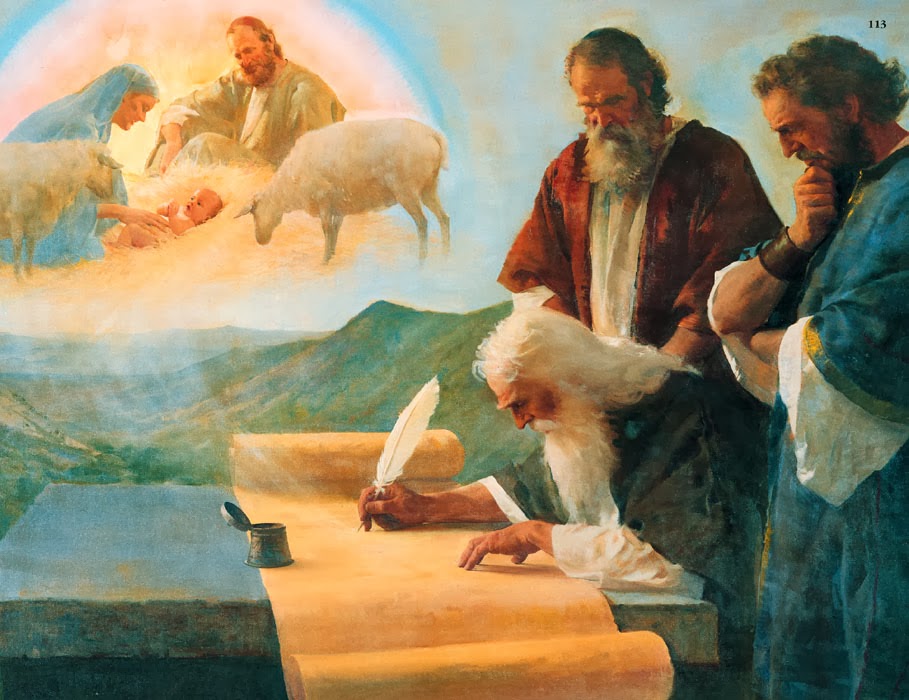
Nephi and Lehi study the words of Isaiah which testify of Jesus Christ

25 And there shall be upon every high mountain, and upon every high hill, rivers and streams of waters in the day of the great slaughter, when the towers fall.
Isaiah 30:25


Related Posts with Thumbnails